

How are You Maintaining Your Depression?
Written By: Brooke Pollard, RSW, RP-Q (OCSWSSW, CRPO)
Oh, depression, a relentless, time-consuming, and foggy, outside-of-self experience that any person can encounter at unique points of their life (Fusar-Poli et al., 2023). Outside of what some of the majority social perceptions and attitudes tell us, depression and its symptoms are not biased to any person or group. Meaning depression can happen to, grow, and debilitate anyone, even those in your life who seem the most unlikely.
Are you experiencing negative thoughts, feelings, and views about yourself? Are you experiencing negative thoughts, feelings, and views about others? Are you experiencing negative thoughts, feelings, and views about the world or society? If the answer is “yes,” you may be experiencing what Moorey (2009) refers to as “the depression mode.” Rather than what is stereotypically or may automatically be perceived as a “negative person.”
To begin to understand your experience with depression and what is possibly maintaining it, Moorey (2009) recommends, to first, examine your environment to see how or what external elements (people, places, situations, things) are acting as limitations to achieving your personal goals. By doing so, this should help provide you with some context and, even possibly, some awareness for dissonance between what is happening externally and internally for you or your areas of growth. Whether it is stemming from in the home or outside in the world.
Now, for the more difficult and, intentionally, introspective question, “How are you responsible for maintaining your experience with depression?” First, let’s talk about how these negative thoughts or schemas automatically come up in the first place, build, and resurface. Negative or dysfunctional schemas are developed from lived experiences when meaning to reinforce these ideas or beliefs that you have about yourself, others, and the world is also assigned. For example, consider a child who made a mistake or froze while giving a class presentation. This child might feel embarrassed and might think, “I am a failure” or “I can’t do anything right” thus, shaping their future experiences and self-directed thoughts or language from having this vulnerable lived experience. The tricky thing is that schemas can lay dormant until another lived experience internally reactivates the schema in question (Iddon & Grant, 2013). Using the same example, what if this happened again while giving a presentation as an adult who is unaware of this problem to begin with? This begs the question, are we our lived experiences or perceived failures? No, but our schemas and thoughts tell us something different.
By taking a closer look at Moorey’s (2009) viscous flower model, you can see how you or another person can internally maintain their own experience with depression. First, automatic negative thinking, which with depression, can resemble thoughts, such as, “I can’t do anything right,” “You’re so worthless,” or “I don’t belong here,” when certain opportunities are presented. Secondly, rumination and self-attacking thoughts can occur like a stream. This may include a cognitive process of re-playing negative thoughts and perceptions about the situation, including all your identified supporting evidence (or other distorted thought styles).
Third, our moods and emotions, such as feeling hopeless, sad, and empty, can make us more sensitive to interpreting events or situations as negative. This can also be exacerbated by low self-esteem regarding your capacity to complete tasks effectively, such as taking reasonable risk or maintaining a daily routine, possibly leading to experiencing issues relating to anxiety and irritability. Furthermore, when we maintain the cycle of engaging in self-attacking and negative thought processes, we maintain our negative core beliefs. This can lead to the fourth stage, withdrawal and avoidance symptoms, which can consequentially contribute to making your internal and external situation and symptoms worse, including our capacity to experience more positive emotions. Avoidance or withdrawal can include the act of intentionally avoiding people, places, and situations that trigger negative thoughts and schemas. Lastly, one’s motivation and physical symptoms linked to depression can have a complex socio-cultural impact on a person’s life due to its other symptoms associated with feelings of hopelessness; thus, impacting one’s drive to make any positive change (Moorey, 2009).
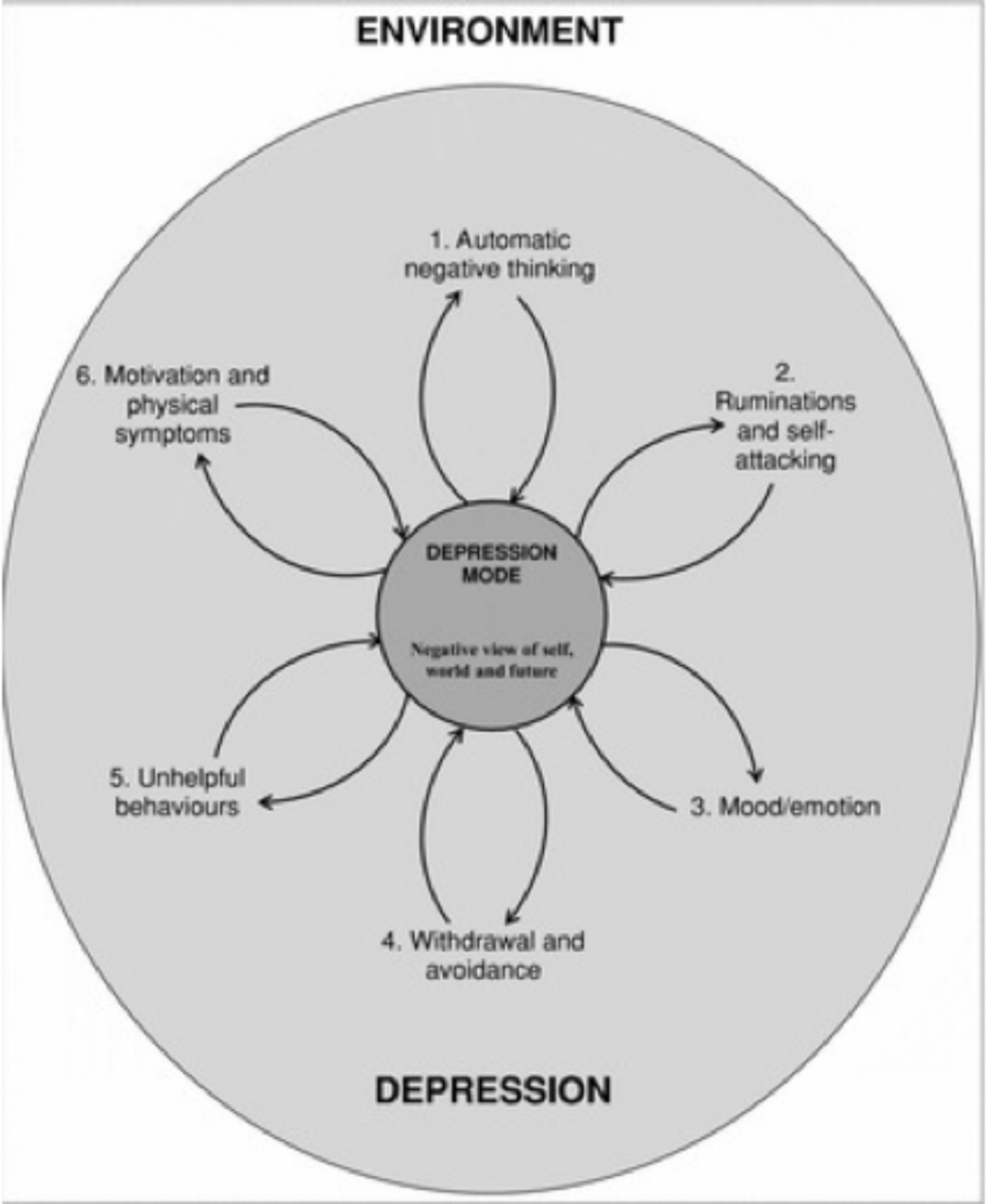
Moorey, S. (2009). The six cycles maintenance model: Growing a “Vicious Flower” for depression. Behavioural and Cognitive Psychotherapy, 38(2), 173–184.
Some or all of these factors working and cycling internally together maintains internal and external depression symptoms. By taking a closer look at each individual aspect of the vicious flower model, you can begin to conceptualize and understand how each aspect interconnects with others, causing your situation to worsen or stay similar. Arguably, if each aspect plays a role in maintaining your situation. Then, making small changes to even one of these areas, like catching automatic thoughts or reframing our internal dialogue from “I can’t” to “I can,” can also make a more positive gradual and long-term impact as well. This can also making and initiating future plans to problem-solve (Cartreine, 2016).
Actor Jim Carrey (n.d.), says it well, “I believe depression is legitimate. But I also believe that if you don’t exercise, eat nutritious food, get sunlight, get enough sleep, consume positive material, surround yourself with support, then you aren’t giving yourself a fighting chance.”
Carrey’s blunt and perspective words also paint the picture of how depression is maintained by knowing both of these sides – how you are not helping yourself and what you “should” be doing – synchronously. Knowing that life is hard and also knowing you are the only person that can make it internally easier for yourself is also, in its own way, difficult. With depression, tasks and the expectation for ourselves can seem too big or unattainable, so rather than taking small steps or radically accepting where you are at, it can feel easier to avoid or give into what your negative thoughts are telling you. “Why make any effort on myself when other people do not care?” “I find everything annoying or boring, so why try?” “I don’t even feel like myself anymore; therefore, I am not myself.” Or, “I feel helpless; therefore, I am helpless.” That’s the depression talking. You are not your thoughts.
When untreated or personally unidentified, depression can cause severe cognitive, emotional, and behavioural symptoms, such as suicidal ideation, difficulty feeling joy, and hopelessness for the future. If you know or are someone who is experiencing suicidal thoughts and need help, The Suicide Crisis Helpline is available 24/7. Call or text 9-8-8 or visit this webpage for more information.
How do you imagine giving yourself a fighting chance and breaking the depression cycle? Where do you see yourself starting? Please visit our webpage for more information about our treatment options for depression, grief (including disenfranchised grief such as miscarriage and pet bereavement) among others and learn how to connect with us and our intake process. There is help available.
References
1. Cartreine, J., PhD. (2016, May 6). More than sad: Depression affects your ability to think. Harvard Health. https://www.health.harvard.edu/blog/sad-depression-affects-ability-think-201605069551
2. Carrey, J. (n.d.). A quote by Jim Carrey. Goodreads. https://www.goodreads.com/quotes/11566346-i-believe-depression-is-legitimate-but-i-also-believe-that
3. Fusar‐Poli, P., Estradé, A., Stanghellini, G., Esposito, C. M., Rosfort, R., Mancini, M., Norman, P., Cullen, J., Adesina, M., Jimenez, G. B., Da Cunha Lewin, C., Drah, E. A., Julien, M., Lamba, M., Mutura, E. M., Prawira, B., Sugianto, A., Teressa, J., White, L. A., . . . Maj, M. (2023). The lived experience of depression: a bottom‐up review co‐written by experts by experience and academics. World Psychiatry, 22(3), 352–365. https://doi.org/10.1002/wps.21111
4. Iddon, J. L., & Grant, L. (2013). Behavioural and Cognitive Treatment Interventions in Depression: An analysis of the Evidence Base. Open Journal of Depression, 02(02), 11–15. https://doi.org/10.4236/ojd.2013.22003
5. Moorey, S. (2009). The six cycles maintenance model: Growing a “Vicious Flower” for depression. Behavioural and Cognitive Psychotherapy, 38(2), 173–184. https://doi.org/10.1017/s1352465809990580